Grades & Specifications
Everything on this page is drawn from the controlled technical data sheet TDS-OA-001 Rev A (effective September 2026) and the grade sheets TDS-AG-001 and TDS-WT-001. Values are representative analyses or published ranges; guaranteed limits are agreed per contract and confirmed per lot by certificate of analysis.
How grades are defined
Every grade is screened and classified from one natural commercial gradation of oolitic aragonite. The chemistry does not change between cuts; the particle-size range does. A grade code therefore identifies a nominal size range and the applications it is normally supplied for, not a different mineral.
Two published grades cover most sand requirements. Where an application needs a different distribution, the material is classified to a written customer specification anywhere in the 20–325 U.S. mesh range.
Reading the status column. Representative analysis is a measurement from an identified sample and describes the material as tested. Published range is a historical deposit range for dried, unwashed material. Customer specification required means the range is set by the buyer’s written spec. None of these is a guaranteed minimum or maximum.
Available grades
| Grade | Nominal particle size | Approx. U.S. sieve equivalent | Sizing status | Typical supply applications | Packaging | Documents |
|---|---|---|---|---|---|---|
| AG-CAL Fine granular |
0.2–0.5 mm | ~70–35 mesh | Published range | Fine substrate and media evaluation; turf and greens mixes; fertilizer and mineral blending; horticultural mixes | Bagged from 1 lb, super sack up to 3,000 lb, dry bulk | TDS-AG-001 (PDF) |
| WT-CAL Coarse granular |
1–3 mm | ~18–7 mesh | Published range | Coarse substrate and media evaluation; process-water remineralization and alkalinity media; pond preparation; carbonate aggregate | Bagged from 1 lb, super sack up to 3,000 lb, dry bulk | TDS-WT-001 (PDF) |
| Custom Classified to specification |
To specification | 20–325 mesh range | Customer specification required | Application-specific classification: blends, private formulations, plating sand, kiln or process feed | Confirmed on quotation | TDS-OA-001 (PDF) |
| Sieve equivalents are standard U.S. sieve openings closest to the stated millimetre range and are given for reference only. Industrial grades GL-CAL (below 0.1 mm, glass batch) and PL-CAL (functional filler, to specification) are quoted through AragoCorMinerals.com. | ||||||
Natural commercial grade: screen size specification
The classified grades above are screened from this natural gradation. Nominal openings are standard U.S. sieve equivalents, given for reference. Source: TDS-OA-001 Rev A, section 5.
| U.S. standard mesh | Nominal opening | Percent retained | Status |
|---|---|---|---|
| 4 | 4.75 mm | 0–1 | Published range |
| 8 | 2.36 mm | 1–4 | Published range |
| 16 | 1.18 mm | 3–11 | Published range |
| 30 | 600 µm | 10–26 | Published range |
| 50 | 300 µm | 40–67 | Published range |
| 100 | 150 µm | 80–98 | Published range |
| 140 | 106 µm | 93–99 | Published range |
| 200 | 75 µm | 99–100 | Published range |
Typical chemical analysis
Chemistry is common to all grades. Analysis by Bowser-Morner, Inc. (AASHTO/ISO 17025 accredited), report 124914A, sample received 12 January 2026; sodium by Precision Enviro-Tech (California ELAP #2387). ASTM C 25 assumes elements are present as specific oxides and carbonates, so compound totals need not sum to 100%.
| Component | Value | Method | Status |
|---|---|---|---|
| Calcium carbonate, CaCO₃ | 96.17% by wt | ASTM C 25 | Representative |
| Calcium, elemental | 38.51% by wt | ASTM C 25 | Representative |
| Calcium oxide, CaO | 53.88% by wt | ASTM C 25 | Representative |
| Magnesium carbonate, MgCO₃ | 0.24% by wt | ASTM C 25 | Representative |
| Strontium carbonate, SrCO₃ | 1.43% by wt | ASTM C 25 | Representative |
| Aluminium oxide, Al₂O₃ | 0.10% by wt | ASTM C 25 | Representative |
| Silica, SiO₂ | < 0.01% by wt | ASTM C 25 | Representative |
| Iron oxide, Fe₂O₃ | 0.01% by wt | ASTM C 25 | Representative |
| Sodium | 0.21% by wt | EPA 6010 | Representative |
| Loss on ignition | 43.50–45.00% by wt | — | Published range |
| Sulfur trioxide, SO₃ | 0.10–0.20% by wt | — | Published range |
| Sodium chloride, NaCl | 0.06–0.25% by wt | — | Published range |
| Moisture, as received | 5–10% | — | Published range |
Physical properties and form
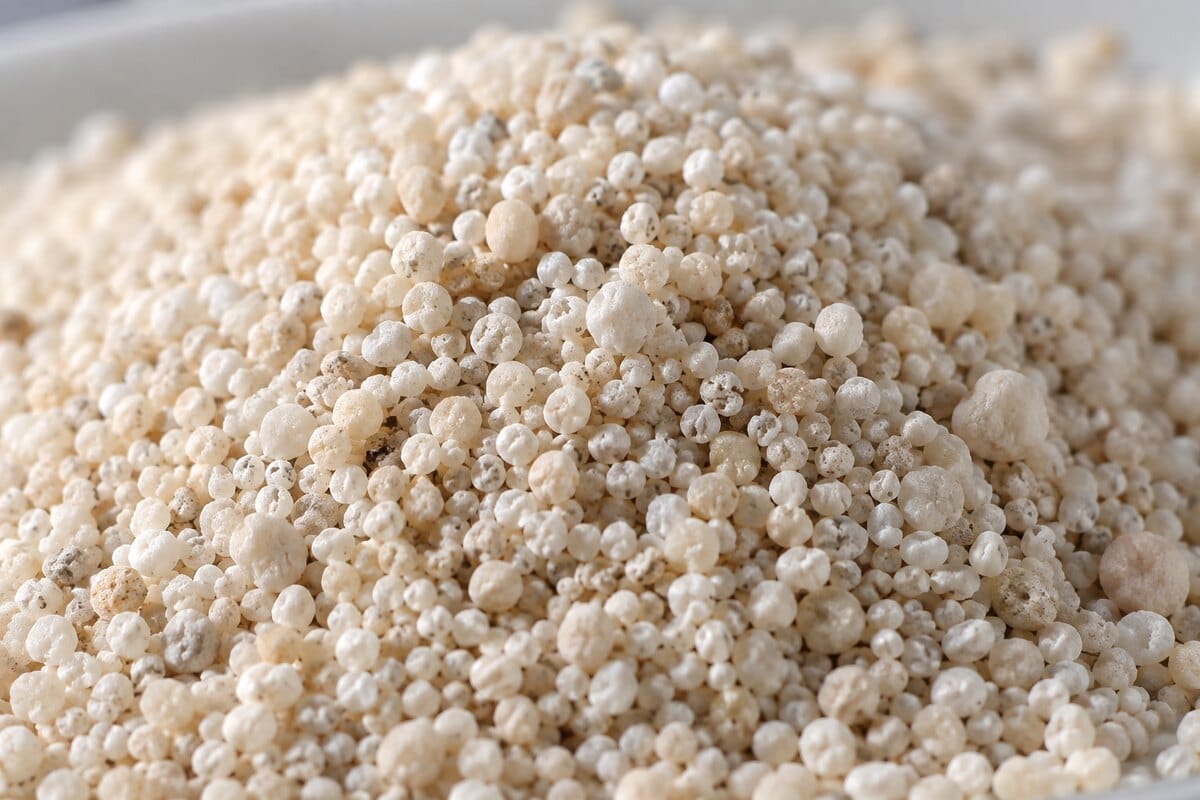
White to off-white, odourless granular solid of rounded ooids. Orthorhombic aragonite polymorph, CAS 1317-65-3. Not regulated for transport (no DOT UN number or label).
| Property | Value | Method | Status |
|---|---|---|---|
| Specific gravity | 2.93 | — | Representative |
| Mohs hardness | 3.5–4 | — | Published range |
| Surface area | > 1.7 m²/g | Keck Lab | Representative |
| Grain size, ooids | 50–500 µm | Microscopy | Published range |
| Sphericity, average | 0.82 | API RP 56 | Representative |
| Roundness, average | 0.87 | API RP 56 | Representative |
| Turbidity | 380 NTU | API RP 56 | Representative |
| Crystal system | Orthorhombic | XRD | Representative |
| Solubility | Insoluble in water and alcohol; soluble in dilute acids | — | Representative |
| Flammability | Not combustible | NFPA | Published reference |
Processing
Mechanical collection, drying below 93 °C, screening and classification. No quarry blasting, no calcination, no chemical treatment, no additives at any stage (manufacturing process document PDS-OA-001). Store dry and covered; shelf life is indefinite when stored dry.
Intended-use guidance and limitations
- Match size to the application
- Particle distribution affects settling, suspension, flow, cleaning, packing, blending and interaction with equipment. Choose the range for the bed depth, flow, process or formulation, then confirm it on a sample.
- Chemistry is condition-dependent
- Aragonite is a carbonate mineral that reacts with acids. Any dissolution, and any contribution of calcium or alkalinity to a system, depends on the operating conditions and the particle size. AragoCor does not specify application rates or process performance.
- Fines, moisture and turbidity
- As-received moisture is a published range of 5–10%. Natural sand carries fines from handling; evaluate initial turbidity and material retention for the process or system it enters.
- Confirm on a representative sample
- Suitability for any particular process, system or formulation must be confirmed by the buyer on a representative sample under the intended conditions.
Technical documents
Controlled sheets are published by AragoCor Minerals and open on AragoCorMinerals.com. Lot certificates of analysis, the safety data sheet and sieve analyses for supplied grades are provided on request.
- TDS-OA-001 Master technical data sheetRev A · effective September 2026 · full composition, properties, sizing, packaging (PDF, 4 pages)
- TDS-AG-001 AG-CAL grade sheetRev A · September 2026 · 0.2–0.5 mm (PDF, 2 pages)
- TDS-WT-001 WT-CAL grade sheetRev A · September 2026 · 1–3 mm (PDF, 2 pages)
- TB-OA-002 Aragonite vs. limestoneTechnical brief · Rev A · August 2026 (PDF, 2 pages)
- OMRI Listed® certificate, product avw-23214Listed 26 June 2026, expires 1 September 2027 · use class: crop fertilizers and soil amendments (PDF)
- On requestSafety data sheet (16-section GHS), lot certificate of analysis, sieve analysis, manufacturing process (PDS-OA-001), source documentation
The OMRI listing covers this calcium carbonate as an input for certified organic crop production. It is published here as a document of record for the same mineral, not as a certification for aquarium, aquaculture or any other application.
Specification disclaimer. Values marked representative analysis are measurements from an identified sample and describe material as tested. Values marked published range are historical deposit ranges for dried, unwashed material, and published reference values are properties of the mineral from a published authority. None constitutes a guaranteed minimum or maximum. A guaranteed specification is agreed in writing per contract and confirmed per lot by certificate of analysis. This information is offered for consideration, investigation and verification; it is not a warranty or representation of suitability for any particular application.
Quote against a specification, not a description.
Send the grade or target range, the application, the order quantity, packaging preference and destination. Documentation and samples can be included in the same request.